Saturday, August 3, 2019

The Sunshine Coast

Never heard of it.  Where is that you might say. This is a quick guide of what we found in a short five day stay.
It is an area just north of Brisbane, Australia. The first thing to realise is that it is a big area, with motorways and country roads all over the place.
Our stay was in two places, first in Caloundra, the second in Marcoola Beach.

The first was a hotel in a place called Golden Beach, which is strange because the sand was white, not yellow.  A yellow sand Aussie beach is a wonderful thing.


Golden Beach is on a tidal inlet with a sheltering island, with sandy mudflats showing most of the time. We were lucky to stay in a nice hotel right on the beach, with a view from the third floor.


All along the beach front is a pedestrian walkway with trees and so on.  Beautifully kept and well used by everyone, who seemed upbeat and friendly, with lots of toy dogs.


If you come here, rent a car, as there are buses, but you would never get a bus to the places we went to.

Our car was a small one, a Hyundai i30.  What a great little car.

Our first outing was a day trip to the Glass House Mountains. Apparently millions of years ago, magma bulged up through weaknesses in the earth's crust, then as years went by the uplifted ground eroded away, leaving spiky outcrops, looking vaguely like glass houses.


Some spectacular views from a lookout, coffee at a cafe overlooking Mango trees, with a butcher bird coming to the window edge to thieve some chips someone left behind.


We were told the small towns were nice and so headed for Maleny and Mapleton.

On the way got quite high up, and got some really nice views.  The towns were ok, but did not look that old, but there was the odd old building.


Back in Caloundra we did a drive around the sea front, which is quite a built up area with apartments.  Seems a popular retirement area. Nice oceanside beaches there too.

On our way to Marcoola, about 30k north, we visited the local air museum, no government funding, just a volunteer run thing.  Then off to the main shopping area to a second hand book shop for some books.  We came back to our car to find a traffic warden about to write us a ticket.  Oops, looks like the sign said 2P in big letters and in smaller writing "meter".

He was good though and said, well you are here now so no problem. We got chatting. It turns out he was a kiwi.  As was the man at the air museum.  As was the girl on the desk at the hotel. So this is where they all are!

Wednesday we decided to check out Noosa and the farmers market at Eumundi.
We had heard Noosa was a posh area, and had in mind that there would be lots of big mansions, but while the houses were nice, they not that ostentatious.


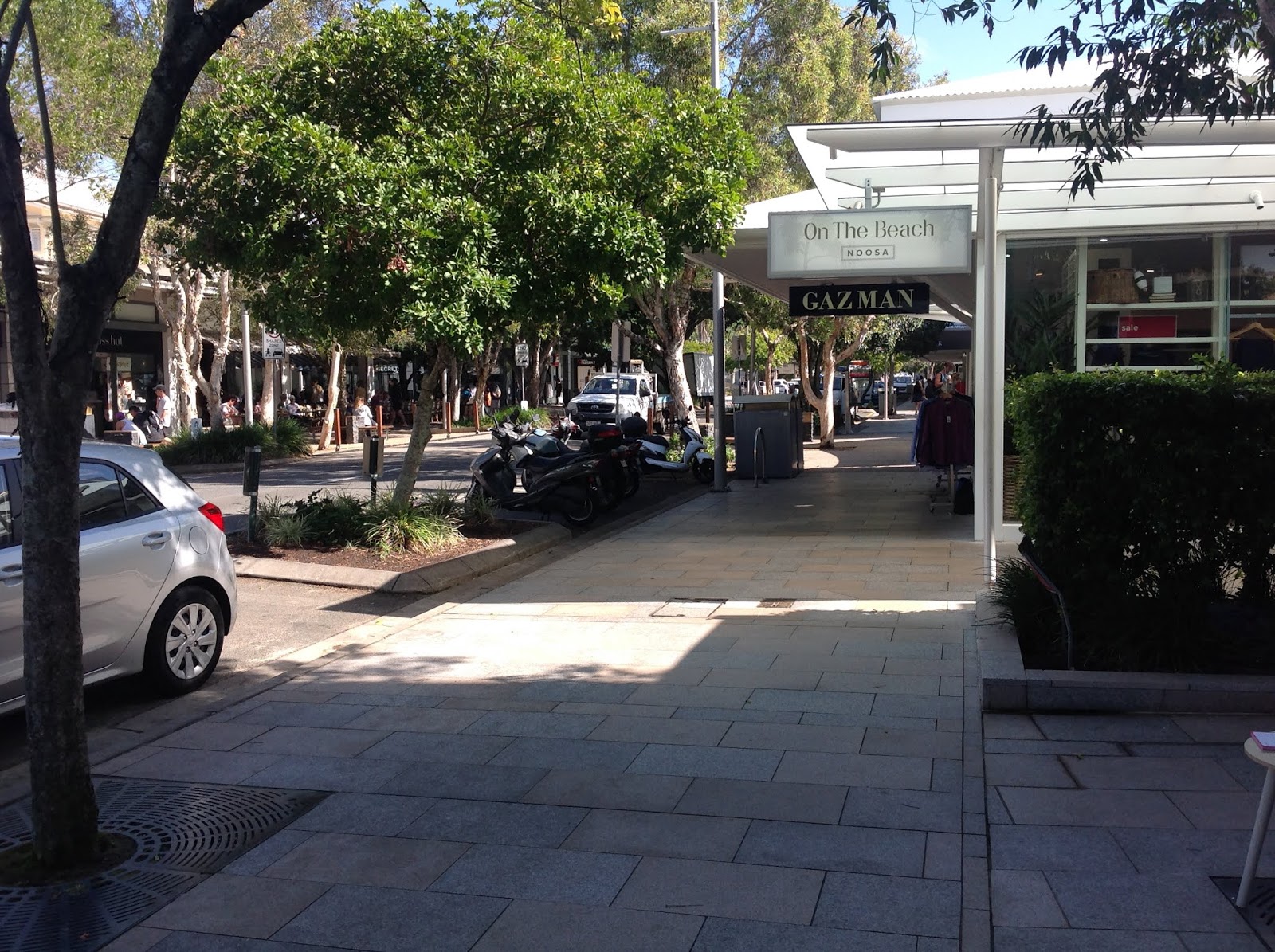
The main shopping street is nicely done up, we went up and down both sides and had coffee in a nice cafe on the beach front. A beautiful beach with nice pedestrian paths around the hills at the beach end.

We thought the markets at Eumundi might be big, but were surprised at just how big.

Not a chance of seeing all the stalls, so had an ice cream and a German sausage for lunch on the hoof.

So here we are, last day.  About to go check out the mall at nearby Maroochydore, which will no doubt be the same as malls everywhere, but you never know.


My swims at Golden Beach were not cold exactly, but not warm.  At Marcoola there was a wind blowing, so even with the sun shining it was not a lot of fun.  The hotel pool was tepid, but again, not warm enough to encourage you to stay a while.


Sunday, March 24, 2019

Tree Appreciation 101

Tree Appreciation 101.

The idea is you look carefully at trees you come across and consider carefully their shape, leaf effect and so on.  We (well most of us), after childhood, just tend to walk past trees and our mind says:
It's just a tree.

A tree is not just a tree. It is an awesome product of mother nature, which we are lucky enough to
wonder at.

So, steps in Tree Appreciation 101:

1.  First, consider it's general shape.  Is it the shape of a ball?  Is it tall and cylindrical? Squashed and like a plate? 

2. Now consider it's symmetry.  Is it all pushed over at one side?  Ask yourself why is that?
For these reasons, check where North is, and where the prevailing wind comes from.  We have a Westerly prevailing wind and it often pushes trees to one side.

3. Consider it's leaves. Are they large or small, shiny or matt? Do you think they are nice looking, if so why?

4. This might need a closer look: What colour is the bark? Is there any lichen on it? What is the texture of the bark?

5. Check out the branches: Are they tortuous, or smooth and lean looking? There is an old Judas Tree near where I live that has branches like corkscrews.

6. Now start on the things that are not seen.  Start with the roots. Imagine you have XRay eyes and can see through the earth and look at the roots.  Feel with your mind: Is it damp or dry soil?  Put yourself in the mind of the tree: how do your roots feel? Nourished? Plenty of water or a bit dry?

7. Look at the trunk: Imagine the tiny bits of water making their way up inside the trunk.

8. Imagine you are inside one of the leaves: have you lots of water to get rid of via the underside?  How about any gases you might be sucking in from the atmosphere? What about giving out oxygen?

 9. Put yourself in the tree's mind. Does it feel happy? Or sad? Why?


Another idea is to imagine you are from another planet, say a desert type one, and you are seeing earth for the first time. Starts to look like an amazing place!

There is a theory that the earth is a living being, which would be nice if it were true-you can almost imagine all things on the surface are connected in some way to the inner earth .

Thursday, February 7, 2019

The "Toe-Runner" phenomenon

I keep telling people about this and they always look politely attentive and make no comment.  Could it be they think I have finally gone fully crazy?

This all started when we lived in Waterview, Auckland, about 10 years ago.  We would take our dog "Carly" for a walk around the block.

We noticed that while walking down our quiet suburban street, sometimes a car would decide to come out of it's driveway, and "run across our toes", hence giving rise to the phrase "toe-runner".

Alternatively, on a street with no traffic, the minute we decided to cross the road, a car would appear from nowhere, and "run across our toes".

Ok, once or twice is coincidence.  Except we began to notice it happened almost every time we went out.

Then we noticed it applied to driving as well-you might be coming down a country road with zero traffic and some person trying to get out of their driveway, and you are holding them up.  This is a case of "reverse toe running"

Even now, if I decide to walk the 3km to work, there will be a someone trying to drive across my toes.

After a while, you suspect the universe is playing games with you......


Wednesday, November 28, 2018

A Blog from Misty the cat

Hi there. My name is Misty and I live in New Zealand with my two humans.

My story is short as I am only three years old.

Here is is pic of me as a kitten in 2015:


I am what is known as a tortoiseshell.  This means my fur pattern looks a bit like the shell of a tortoise.  Tortoiseshells are almost always female.  They are also known for their naughty nature, hence the name "naughty tortie".  I am not a cuddly cat, and if you get too familiar, you will get a warning nip or a bat across the face.  Having said that, I do enjoy sitting all over my two humans.

My story starts in Tauranga, where I was born.  At some time in January 2015, I was a kitten, a bit lost and trying to cross the road, and was hiding in the gutter considering my next options when one of the metal turtles stopped and a human with long hair got out, approached and picked me up.

She took me to the only house nearby where someone leaned out the window and probably said that I was a stray.

Huh?! So I get a terrifying trip to Auckland in the metal turtle. Well, I had to go toilet somewhere didn't I?

I immediately settled in my new home in Auckland and set about the wearisome task of educating my two humans.  I had a great kitten hood, getting under the house, avoiding other cats, and catching crickets, and running along 1800mm high fences.

About May 2015 my humans shifted house to Pukekohe, a little town about 40 minutes south of Auckland.  I enjoyed this move as there is a pond just over the back fence, with ducks, frogs and so on.

Here is me all grown up:


In the new house the humans have not installed a cat door, so I have to tell them I want to come in by launching myself at the bedroom ranch slider.

At one stage they used to leave the bathroom window open so I could come and go as I pleased.
And I did, sometimes at 3am with a mouse or bird or cricket in my mouth, whereupon the human with no hair would swear at me and remove the livestock and if alive put it back outside.

Sometimes they got very grumpy, like the time I brought a frog in to show them how smart I am.
These things scream like a baby!  The final straw was the night I brought in a rat.  This involved much excitement from the human with no hair, and confining of me and the rat in the spare bedroom where he indicated I should grab the rat and take it back outside.  I was not too keen on that idea, as now I could see it clearly, it looked a bit too big, so I decided I would just keep up a watching brief.
I will not go into the disposal details here, but I believe it involved an axe.

So after that the bathroom window was shut at night and I have to knock on the ranch slider to be let in.  A body search for livestock is then performed.

For a while, I used to catch little birds called swallows and leave the skull and a few feathers at the front door.  The human with no hair really loves these birds and he asked me not to be killing them, so I have laid off doing that lately. Or is it that I have become a bit heavier and unable to leap the required 1500mm off the ground?

Monday, November 12, 2018

Rarotonga


 This is a guide, what you might like to know if you were thinking of visiting the Cook Islands.

 We stayed on the main island for 7 nights.  It seems quite big, but you can drive around it in about 50 minutes.  

The interior is uninhabited mountains, which are very scenic. All the population lives in a thin strip around the edge with a paved but bumpy road which can be be busy with locals on small motorcycles. The lived in part seems roughly half locals and half hotels with quite a few churches.

Gauging how nice a hotel is difficult from the road as the nicest part is usually by the sea.  The one we stayed in, Manuia Beach Resort, was a boutique hotel, meaning no children allowed and slightly dearer  than ones down the road. Strange how some humans think?
Or is it the cheap one is three stories high, so you need to get in a lift to go to the beach? You were able to snorkel off the beach but you had to wait a bit for the tide.

We liked it as it had sandy paths and chickens strolling around. Right now we have a mother and it's chick cheeping for food at the door. 

To rent a car or not? It took four days for us to cave in to that idea. Our experience was that it was a good idea as it was not that expensive about $160 for two days plus petrol. Petrol was about the same price as NZ, so not too bad.

It gave us the flexibility to try a restaurant down the road, The Tumunu, where I had a scallops and calamari and chips which I thought good value.  Prices for meals here are a bit high, but take in the idea that everything is imported, it starts to explain why.
For instance, a 500g pack of butter was over $10.

There are things to do, like go into see the main town, Avarua, or go on a lagoon cruise, which for pickup, drop off, lunch, entertainment and snorkelling was around $160, so not too bad.

A typical day might be a trip 4 k down the road to the marine reserve, which while not over run with fish certainly had some to see, with fantastic visibility.

On Saturday they have the local markets. Another thing is dogs.  Apparently homeless dogs wander around, and sometimes in the small hours you hear a lot of barking in the distance. Then a rooster starts crowing. Plenty of crops growing, some of which we can only guess at.

The weather for our stay was a bit unlucky, overcast and windy mostly. A perfect day, now we are leaving.

The currency here is NZ $, but there seems to be the odd coin that says Cook Islands, which would not work in NZ.


On the second day, Morty the cat appeared and made himself quite at home thank you. Not to be seen again much as he must have found even more cat friendly suckers nearby.

Saturday, September 1, 2018

Coff's Harbour

A short stay here, just four days.  We stayed in The Terraces, a Wyndam Hotel just 5 minutes north of Coff's Harbour township. With a population of 75,000, it compares with New Zealand's Whangerei which has a population of about 51,000.

Impressions: a seaside resort town with the main Pacific highway running through it. Usual cafes and restaurants, with a nice central shops area.

View from the terrace at the Hotel:


 A Bush Turkey at the Hotel:


Off our terrace saw Black and White Crows, who were eating the berries off the palm trees:


 From the Hotel, you can walk a cliff path to the next beach, which is Digger's beach. This is looking back northwards on the way to Digger's Beach:


The waterfront area is extensive with a good beach.  Australian sandy beaches are better than in NZ, nicer colour.

This is Digger's Beach  which is nearby:


This is a small town close by, called Urunga:


What to do? Not much, one day took a trip to Dorrigo, a small town about 1 hour inland.  You set out on fairly flat farmland, and end up climbing into a sizeable mountain ranges.

 On the way there you go through Bellingen, another small town, very old:


Up there is a National Park with a bush walk, where we tried to make it to the waterfalls, but ran out of steam.

This is a view from the bush walk at Dorrigo:


This is a waterfall, just out of Dorrigo:


Friday, July 27, 2018

To diet or not to diet?

Seems a break from my usual travel blogging.
Just some thoughts in case there are others out there who have the dieting disorder.

I might have a mild case of this.  We could argue that it is a wise idea to keep tabs on what you are eating (and how much!), and exercising is surely a good idea. Just when it slips into a neurotic behaviour is a grey area.

Having  been through several weight loss programs, I have experienced the fun of losing weight.
It is really great - you are not carting 10kg extra around all the time.

They worked, but the weight seems to creep slowly back up when I go back to my normal diet. 

So, in the library browsing for books I found two books on the subject.

"The Overfat Pandemic" by Dr Philip Maffetone and
"Solving the Paleo Equation" by Dr Garrett Smith.

This blog is not a review of these books, just an introduction to some of the key ideas they put forward.

Which leads to the moral of this story: Don't just get ONE book out! Because every where you look there is a huge amount of advice in this area, especially the internet, which is probably at  best case mostly wrong, and worst case dangerous.

Both books emphasize getting rid of junk food from your diet.

"The Overfat Pandemic" has an interesting two week program you can do, which is where your eliminate all carbs from your diet for two weeks. I lasted 1.5 weeks on that one. Might have to go back for another try.

The idea is you monitor your weight and at the end of two weeks see if reducing the carbs in your diet results in a weight loss. In my case it was only a slight loss.

"Solving the Paleo Equation" seemed like a better approach with some shattering of myths(?) such as you need to drink around 3 Litres of water per day.  I have tried that one on a previous diet and could not keep it up.

He says this is wrong.  Drink when you are thirsty. His main message is that you have to consider all the following: Stress, Nutrition, Exercise and Sleep.  Which to me sounds logical.

Another myth he busts is "No Pain, No Gain", which he says is not the right approach.

He lists various things you should eat, mainly red meat or wild caught fish,  stay away from pork and poultry. Avoid deep fried foods at restaurants. (Makes me a bit sad that one-I enjoy fish and chips)

An unusual list of "Anitmetabolism Foods" to avoid he lists as beans and legumes, and cruciferous vegetables such as Kale, Cabbage, Cauliflower and so on.  Which is strange because most nutritionists say eat all the veges you like.

At the end of the book is a section on Cell Phone/Wifi radiation which has solutions I would find very difficult to implement. Who knows, he may be correct.

Starvation dieting is not good for you and there are other approaches.